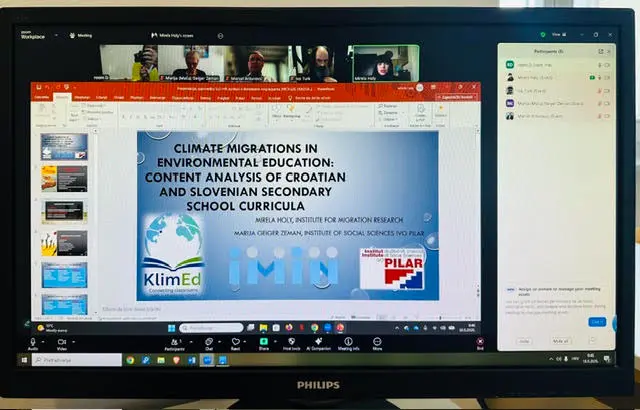
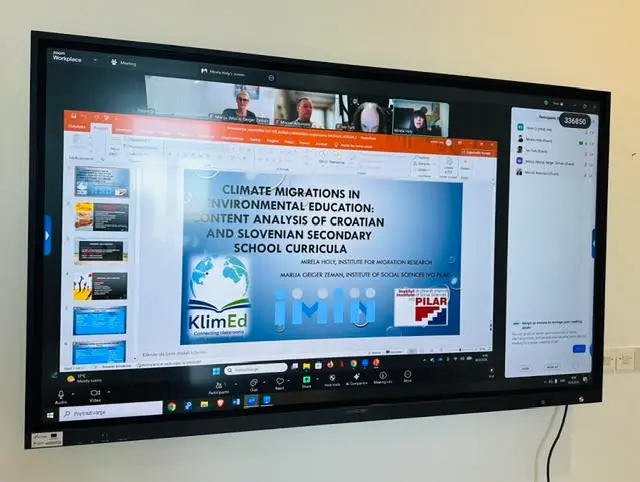
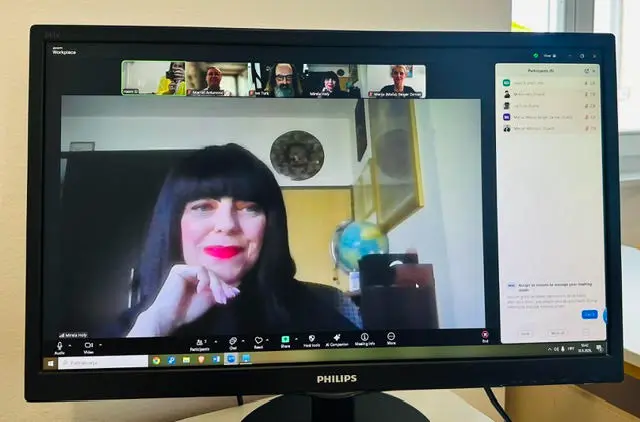
Dr Mirela Holy, Principal Investigator of the KlimEd project and Scientific Adviser at the Institute for Migration Research, and Dr Marija Geiger Zeman, Scientific Adviser at the Ivo Pilar Institute of Social Sciences and a KlimEd project researcher, presented the findings of a comparative analysis of Croatian and Slovenian secondary school curricula at the MIC Vis 2026 international scientific conference.
The presentation was delivered on 18 September 2026 under the title “Climate Migrations in Environmental Education: Content Analysis of Croatian and Slovenian Secondary School Curricula”. It examined how climate change, migration, and their interconnections are represented in secondary education in two neighbouring European Union Member States.
The research was conducted within the project Climate Migration in Education: Innovative Educational Media for Understanding Intersectional Crises (KlimEd), funded by the Croatian Science Foundation.
The study was based on a comparative qualitative content analysis of 59 curricular documents, comprising:
- 19 Croatian curricular documents
- 40 Slovenian curricular documents
The analysis examined the representation of climate change, migration, and their interconnections, alongside educational content addressing climate justice, global inequalities, responsibility, empathy, and active citizenship.
Key findings
The findings revealed that climate change is considerably more visible than migration in the curricula of both countries, while the relationship between the two remains insufficiently addressed.
In Croatian curricula, climate change is primarily discussed within sustainable development, geography, and natural sciences, whereas migration is predominantly approached as a demographic and social phenomenon.
As many as 15 of the 19 Croatian documents analysed contained no relevant migration-related content, while explicit connections between climate change and migration were exceptionally rare.
Slovenian curricula demonstrated a somewhat more developed approach to connecting climate change and migration. Issues such as climate justice, global inequalities, environmental migration, and active citizenship were more prominently represented.
Nevertheless, climate migration has not yet been systematically integrated into Slovenian curricular content.
The central finding of the study is that the main challenge is not a complete absence of knowledge, but rather its fragmentation.
Climate change and migration are generally addressed as separate topics, limiting opportunities for students to understand their complex political, social, economic, and humanitarian interconnections.
The presenters emphasised the need for an interdisciplinary and intersectional educational approach that connects existing curricular content with human rights, climate justice, global inequalities, solidarity, and active citizenship.
Importantly, this does not necessarily require the introduction of new school subjects. Instead, the findings point to the need for better integration and coordination of existing educational content. of a rapidly changing world.