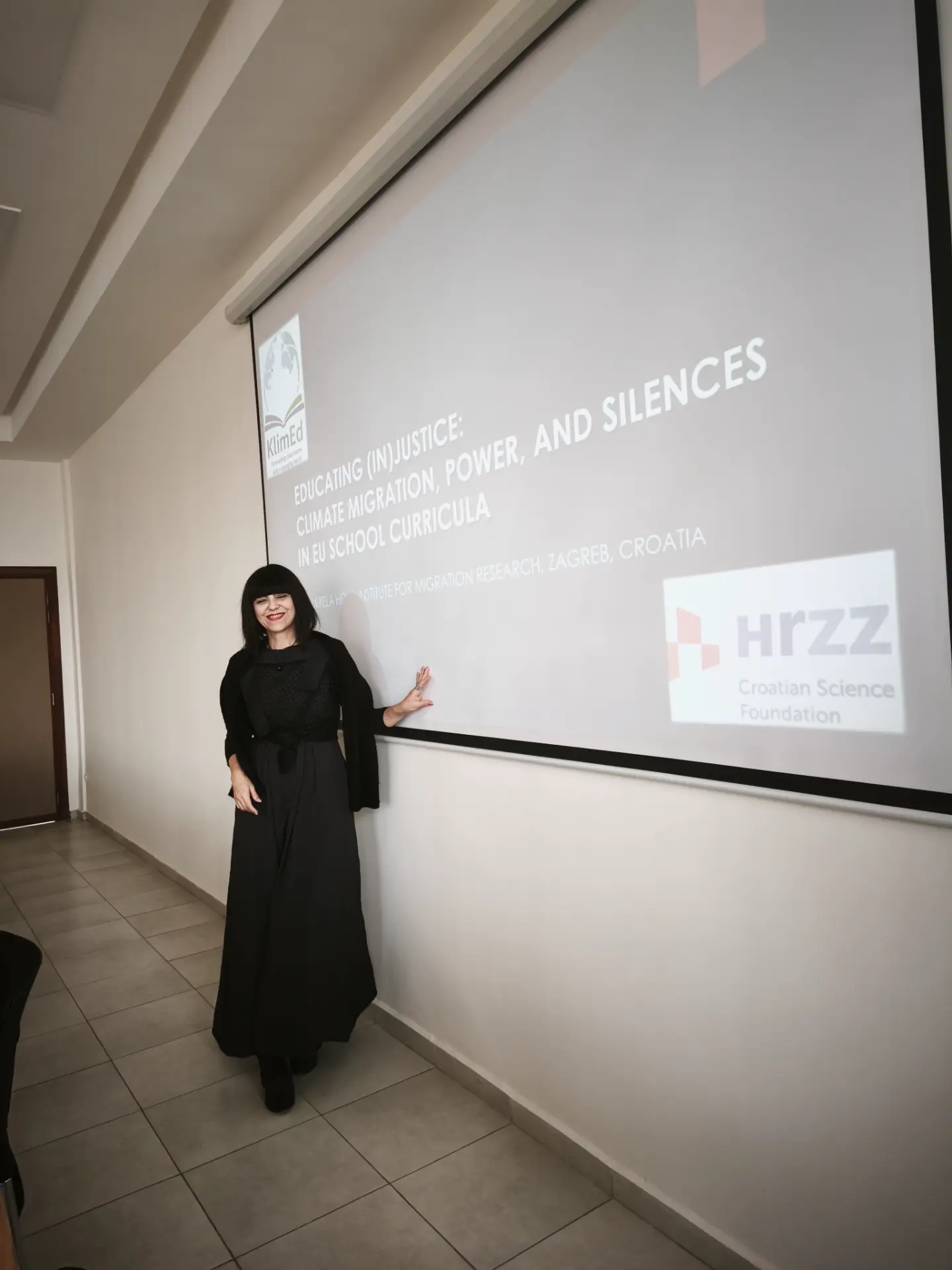
Dr Mirela Holy, Principal Investigator of the KlimEd project, participated in the first IMISCOE Forum, held in Agadir, Morocco, from 28 to 30 October 2026, where she presented research findings on the representation of climate migration and climate justice in European school curricula.
The Forum, entitled “Promoting Afro-European Mediterranean Dialogue: Shifting Geographies of Migration”, was organised within the framework of IMISCOE (International Migration Research Network), in cooperation with Ibn Zohr University in Agadir.
The event marked the first IMISCOE Forum, established to promote and strengthen scientific dialogue between Europe and Africa on migration, with particular emphasis on the equitable exchange of knowledge, research perspectives and experiences among scholars from both continents.
The Forum provided an opportunity to critically reconsider dominant Eurocentric approaches to migration research and to foster new forms of international academic cooperation.
Throughout the three-day programme, participants discussed a range of topics, including:
- migration governance and border policies,
- climate change and environmental mobility,
- gender and other social inequalities,
- colonial legacies,
- alternative and decolonial approaches to migration research.
Presentation of KlimEd Research Findings
Dr Holy delivered a presentation entitled “Educating (In)Justice: Climate Migration, Power, and Silences in EU School Curricula” during the panel “Climate Change and Environmental Mobility”, held on 28 October 2026.
The presentation drew on research conducted within the project “Climate Migration in Education: Innovative Educational Media for Understanding Intersectional Crises” (KlimEd), funded by the Croatian Science Foundation.
The presentation outlined findings from a qualitative content analysis of scientific literature on climate migration and climate justice, complemented by a comparative analysis of secondary school curricula in selected European Union Member States.
Particular attention was paid to how educational content addresses the relationships between climate change, migration, social inequalities, historical responsibility and power relations.
Key Research Findings
Findings suggest that climate-induced migration is predominantly represented through depoliticised narratives of risk and adaptation, while issues of climate justice, resource conflicts and migrant agency remain marginalised or entirely absent from educational content.
The presentation highlighted the importance of education in shaping societal understandings of climate migration, as well as its potential role in either reproducing or critically challenging existing global inequalities.
Participation in the IMISCOE Forum contributed to the international visibility of the KlimEd project and facilitated the integration of its research findings into the broader Afro-European scientific dialogue on climate migration, education and climate justice.